

What’s The Difference Between Analog & Digital Faxing?
For over 50 years, faxing has been used by governments, financial institutions, law offices, medical professionals, and many others to transmit documents securely over large distances. But over the years, faxing and the way we communicate have changed. The internet has made it possible not only to instantaneously send and receive documents, but also to store them online for access from anywhere.
Faxing has evolved as the internet has evolved, and it’s now possible to fax over the internet with digital faxing. Although it’s much more convenient to send and receive faxes, traditional faxing is still used by some businesses and institutions — in fact, digital faxing often operates alongside traditional faxing.
So what’s the difference between traditional and modern faxing? Do they work with one another? Which one is best for you?
In this post, we’ll answer questions about digital versus analog faxing. We’ll also explain how traditional faxing works and how it differs from modern faxing.
What is Analog Faxing?
First, what does analog mean? Analog means using continuous signals, like electrical waves, to transmit information, rather than digital bits (0s and 1s).
Analog faxing uses phone lines to transmit a facsimile (or copy) of a document over long distances. Even though analog faxing may be considered “traditional,” it’s still advanced, as it requires the document to be scanned by a fax machine and converted to a format that can be transmitted over a phone line.
We cover this more in our post about how faxing works.
Analog faxing caught on in the 1960s when offices and businesses began using fax machines. So, why is analog faxing called “analog”?
Because a faxed document is converted to an analog signal that’s transmitted over a phone line. That’s right: A fax machine requires a phone line. While the phone line doesn’t need to be dedicated to only the fax machine, if it’s in use the phone line can’t be used to make calls.
Additionally, when a fax machine sends or receives a document, it requires physical paper to scan or print the fax. This means you need a printed version of your document to send, as well as ink or toner and paper to print documents that you receive. This can get costly and can be inconvenient. Analog faxing is also slower, as it transmits over a phone line via recognizable “dial tone” sounds.
In summary, analog faxing:
- Requires telephone lines
- Operates with hard copies of documents
- Is slower than digital faxing
- Requires a dedicated fax machine that uses paper and ink or toner
What is Digital Faxing?
Conversely, what does digital mean? Digital means using data in binary form — 0s and 1s — to store, process, or transmit information.
Digital faxing, unlike analog faxing, doesn’t require a phone line. With the internet, transmitting documents and information over the web became far quicker and convenient.
Digital faxing uses a fax over internet protocol (FoIP) to convert a document into data that can be received by a fax machine.
Digital faxing is faster, more convenient, and uses fewer resources than analog faxing does. It also works with analog systems, so you can send faxes to anyone, even if you (or they) don’t have a fax machine.
However, digital faxing does require the use of a faxing service like Fax.Live to send and receive faxes. Unlike analog faxing, you can’t just plug in a machine and start sending and receiving your faxes. You’ll need a digital fax service that handles conversion, transmission, and storage for you. This is less costly than buying a fax machine and paying monthly for a dedicated phone line.
Analog and Digital… What’s the Difference?
There are a few key differences between analog and digital faxing:
- Transmission speed: Digital faxing is usually much faster than analog. Speed depends on the number of pages you’re faxing. See How long does faxing take?
- Security: Both have risks. Analog faxing may be harder to intercept during transmission, but printed faxes can end up in the wrong hands. Digital faxing relies on passwords, multi-factor authentication, and encryption.
- Cost: A digital faxing service charges a fixed monthly fee with no setup costs. Analog faxing requires the purchase of a fax machine, printing supplies, and a phone line.
- Accessibility: Analog faxing requires you to be near the fax machine to send or receive documents. Digital faxing works anywhere, at any time, from an internet-connected device — laptops, desktops, smartphones, and tablets.
- Scalability: An analog fax machine can be a bottleneck for sending or receiving. A digital fax service accommodates multiple users at a time.
- User experience: Fax.Live has a simple interface to send and receive documents. Fax machines can be tricky (and frustrating) and often require troubleshooting when things go wrong.
- Document storage: Analog faxing prints received faxes, which require physical storage. Some fax machines offer limited memory storage. A digital fax service like Fax.Live includes cloud storage, so you can access your faxes anywhere.
- Confirmation and tracking: With digital faxing, you’ll receive email and dashboard updates about your fax statuses. You’ll know if it’s being transmitted, sent, or received. With analog faxing, you have to check the machine manually.
Do Analog and Digital Faxing Work Together?
Yes, digital faxing still works with analog faxing. Some institutions, especially in the medical and legal fields, still use analog faxing because it works with their existing infrastructure. Digital FoIP can transmit documents to physical fax machines.
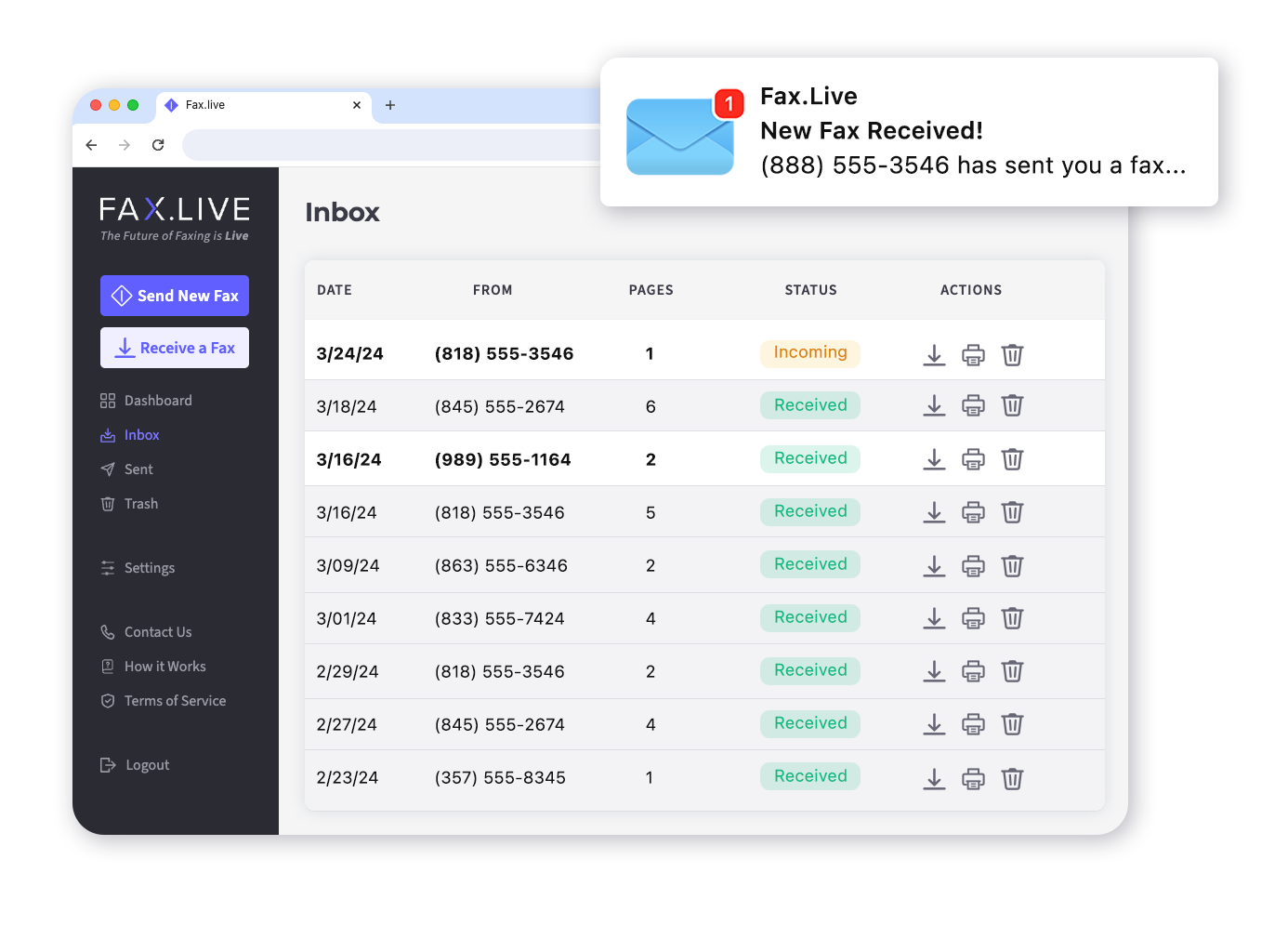
Analog faxing also works for sending documents to digital fax services. Fax.Live, for example, is a digital fax service that provides you with your own free fax number. When someone sends you a fax, you’ll receive an email notification that you have a new fax and can download or print it at any time. You don’t need a phone line, paper or ink.
ID 31518594 | Analog Vs Digital | Acinquantadue | Dreamstime.com